
Marshalltown data center debate rages on during latest council meeting
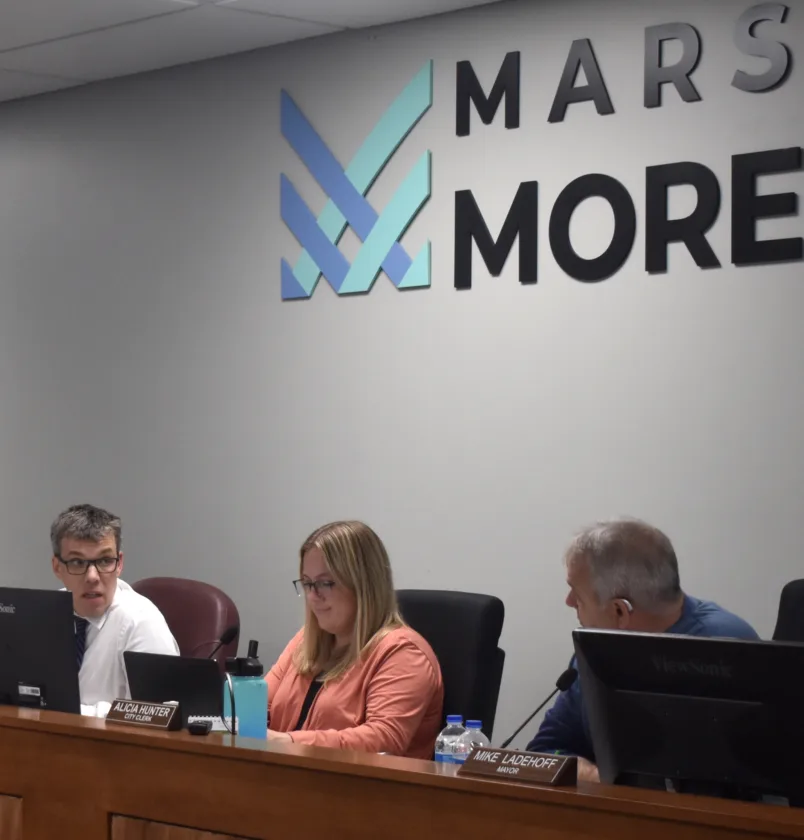
Marshalltown City Attorney Steve Leidinger, left, speaks while City Clerk Alicia Hunter, center, and Mayor Mike Ladehoff, right, look on during Monday night's city council meeting.
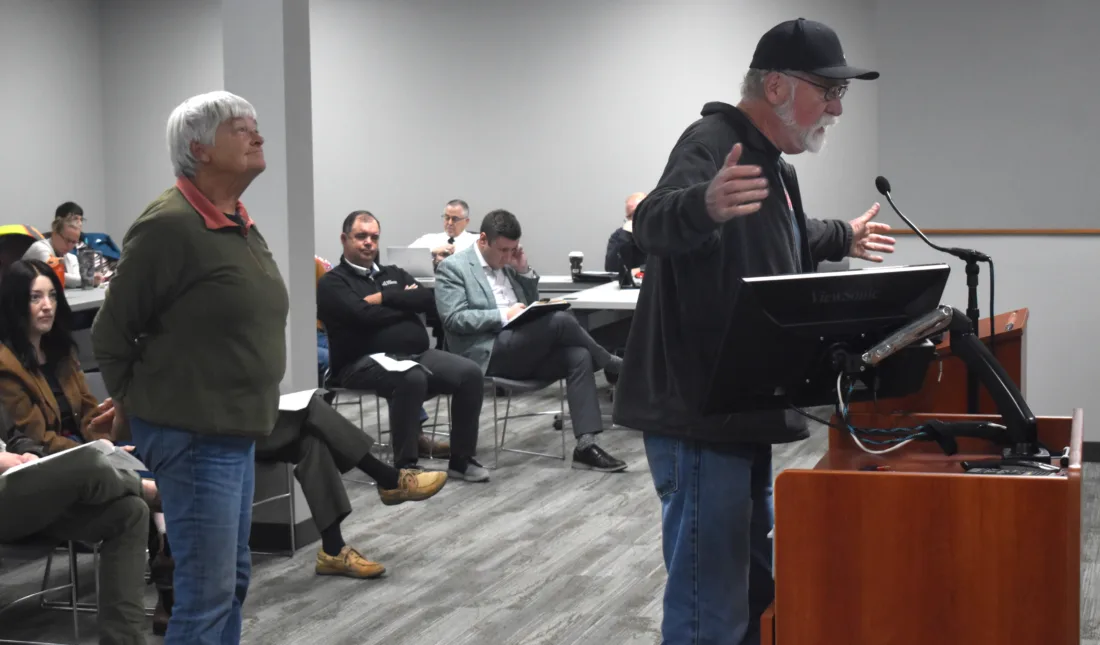
T-R PHOTOS BY ROBERT MAHARRY Marshalltown resident Jimmy Landt, right, addresses the city council during Monday night's meeting as Joleen Ballard, left, waits for her turn.
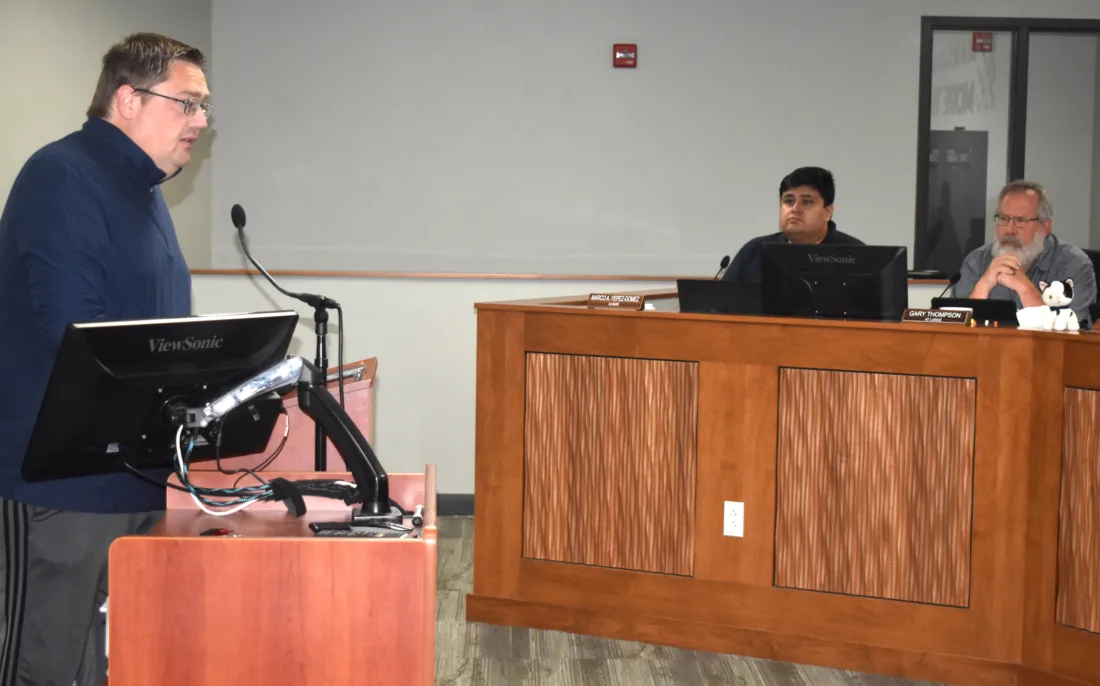
Fairfax City Councilman Dan Wozniak attended Marshalltown's city council meeting Monday night to speak out against Alliant Energy and data centers as the small suburban community has been impacted by construction in nearby Cedar Rapids.
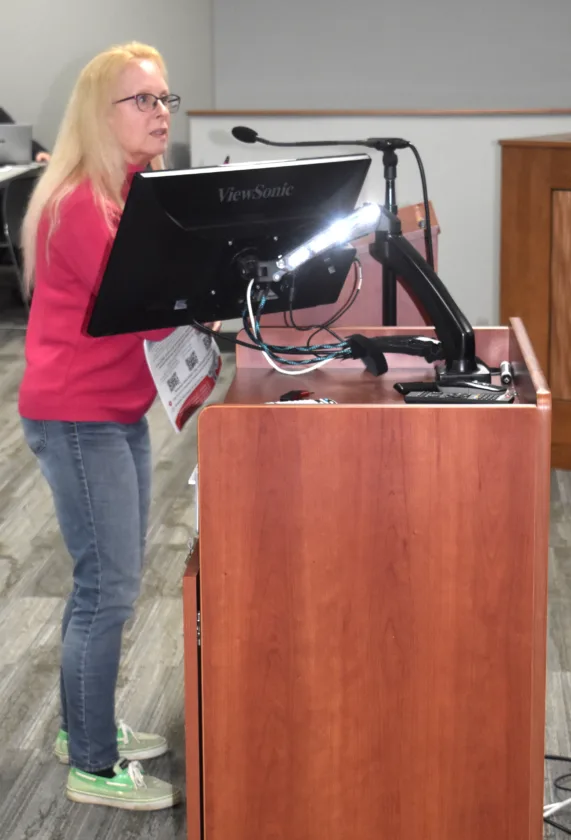
Fairfax City Councilwoman Cindy Anderson also attended the meeting and expressed similar sentiments to Wozniak.
Marshalltown City Attorney Steve Leidinger, left, speaks while City Clerk Alicia Hunter, center, and Mayor Mike Ladehoff, right, look on during Monday night's city council meeting.
T-R PHOTOS BY ROBERT MAHARRY Marshalltown resident Jimmy Landt, right, addresses the city council during Monday night's meeting as Joleen Ballard, left, waits for her turn.
Fairfax City Councilman Dan Wozniak attended Marshalltown's city council meeting Monday night to speak out against Alliant Energy and data centers as the small suburban community has been impacted by construction in nearby Cedar Rapids.
Fairfax City Councilwoman Cindy Anderson also attended the meeting and expressed similar sentiments to Wozniak.
Trending
(Editor's note: This is the first story in a series regarding Monday night's city council meeting and the ongoing debate over data centers and the proposed regulations surrounding them in Marshalltown.)
Fresh off of a meeting that clocked in at about 4 ½ hours two weeks ago, the Marshalltown city council reconvened on Monday night and spent well over three hours discussing the topic that has dominated the conversation for several months now -- data centers.
After hearing general public comments, approving the consent agenda, honoring cross country state champion and all-time record holder Preston Johnson and approving the council calendar for 2027, the focus shifted back to approving a set of proposed regulations that would govern data center development within the city: mostly second readings, but a first reading on the zoning ordinance due to substantial changes during the last meeting and a referral back to the Planning and Zoning Commission for further review of the specifications on what would trigger a special use permit requirement as opposed to administrative approval.
Assistant Housing and Community Development Director Clayton Ender worked through the first several ordinance changes relatively quickly, as the second reading of the new ordinance requiring connection to the public water system saw one amendment proposed by Councilor Jeff Schneider, which would allow the use of reclaimed treated wastewater for industrial cooling uses. Schneider's amendment passed by a 6-1 tally with Councilor Marco Yepez-Gomez opposed, and the amended ordinance passed by a unanimous vote.
From there, the council considered the second reading of an ordinance restricting the drilling of private wells for any purpose when connection to the city's water system is "reasonably available," and Ender said Marshalltown Water Works (MWW) is only aware of one property that would be affected by the change. It quickly passed unanimously.
The second reading of the noise control ordinance clarifying how the city measures sound, how numerical limits apply and how routine generator testing and emergency operations are handled. Yepez-Gomez proposed an amendment allowing for a more restrictive noise limit as a condition of approval without changing the generally applicable limits in areas used to "quieter sounds."
Schneider argued that because data centers would only be allowed in general industrial zoned areas, he didn't see the point of the amendment. During the public comment period, Layne Pieri expressed support for the amendment, while Tim Bradbury worried that it could interfere with freedom of speech and religion for groups that want to sing and play music in public. Jim Palmer worried about the effect the limits could have on other businesses like his, and Dan Wozniak, a Fairfax city councilman who had already spoken out against Alliant Energy during the general public comment period, said protections should still apply even in industrial areas.
Yepez-Gomez's amendment passed by a 5-2 vote with Schneider and Greg Nichols opposed, and the amended ordinance then passed by a unanimous 7-0 vote. From there, the council moved into the agenda item that would consume the lion's share of the meeting: the first reading of the zoning ordinance and review framework related to data centers with a host of proposed amendments.
After providing a summary of the ordinance as presented, Ender also listed a series of proposed amendments and noted that the P&Z Commission recommended approval of an amendment lowering the threshold triggering a special use permit requirement to 40 acres or more than one story for a proposed data center.
With the public hearing underway, a flurry of commenters spoke for well over an hour -- unsurprisingly, after David Engel first spoke in favor of data center development, most of those who followed were either opposed outright or supportive of extending the ongoing moratorium to allow for stricter regulations to be enacted. Jan Diamond of Diamond Roots LLC, who farms land near the proposed overlay district on 18th Avenue, asked the council to eliminate the overlay and evaluate proposals on a case-by-case basis through the special use permit process. She argued that developers were after "our land, our energy, our water and our silence" and quoted the old Joni Mitchell line, "Don't it always seem to go that you don't know what you got 'til it's gone" in reference to Iowa's farmland. Her husband, finishing her written comment, worried that a data center near their land could negatively affect their farming operation and urged the council to reject the establishment of the overlay district, which grants administrative approval for single story projects on under 40 acres of land.
Rose Fricke cited recent election results where voters in local referendums across the country opted to ban data center development, and she urged the council to look beyond the opportunity for city revenue and ban them until state and federal lawmakers set more uniform guidelines.
"I would love to have a new car, but I have to drive the car I have and maintain it. I would love to go to Paris, but I only have money to go to Missouri. We have budgets. We have to learn to live with the money that we have," she said. "Do not make this a financial decision. Make it a moral decision."
Jimmy Landt, a Vietnam veteran who was exposed to Agent Orange, reiterated his frustration that his concerns on toxic waste haven't been addressed, and he hasn't received answers from the mayor or council.
"Safety's worth more than money. My health is worth more than money," he said.
Mayor Mike Ladehoff responded that it was hard to provide any concrete answers on batteries and emergency response without a specific proposal to consider. Joleen Ballard felt decisions on data centers should be made at the local level, and Zach Hamilton, who lives on Shady Oaks Road, called for protections and accommodations for affected nearby residents if land is annexed for a data center in the future.
Pieri wondered why the stricter guidelines regarding electrical and water use in the earlier drafts of the ordinance were removed from the version before the council. Daleen Michel advocated for special use permit requirements regardless of the development size, and Gina Tomlinson worried about the environmental effects of a data center near home on the northeast side of town.
Lea Husak argued that the economic benefits of data centers were overstated and worried that regulations may not be enforced, and Wozniak returned to the podium to ask whether the city's future was for sale, again criticizing Alliant.
"Alliant needs data centers because they need to build infrastructure. They need to justify building infrastructure so they increase rates for their ratepayers," he said.
He added that documents showing who will pay construction costs are hidden behind confidentiality and non-disclosure agreements (NDAs), and Wozniak said data centers get a discounted rate on their electricity. Fairfax, a small town located just outside of Cedar Rapids, now has 13 data centers within close proximity due to the construction boom nearby.
"The unfortunate thing is we get no benefit from that because they're all in Cedar Rapids, but we get the fun traffic that comes through -- 12,000 cars twice a day will pass through," he said. "Four times the amount of (people in) our city passing through."
The construction crews the developers hire, he said, are mostly from out of state, and light pollution has also become a major issue. Heidi Ernst, like Wozniak, called for extending the moratorium, and Michael Gabler, who said he "really likes" living in Marshalltown, worried that they would permanently change the city in a negative way and didn't think the council should rush to welcome a data center just because it might be built somewhere else if they say no.
Doris Kinnick, a farmer's daughter, quoted a lyric from the song "McArthur" and opined that farmland should not be used for anything but farming. Cindy Anderson, who serves on the Fairfax city council alongside Wozniak, restated many of his complaints about the negative impacts of data center construction on their community and warned about deceptive tactics used to convince landowners to sell their property to developers. She also didn't feel that the Board of Adjustment, which is comprised of volunteers, should make any final decisions.
"When they dangle the carrot in front of you, you're not getting all that carrot," she said, citing the tax abatements QTS and Google have received in Cedar Rapids. "Take your residents' feelings, their wants, their needs, their concerns to heart."
Ladehoff broke up the round of applause that erupted in the crowd after her remarks, and Roberto Gonzalez called for extending the moratorium and listening to residents. Maggie Valentine expressed concern about data centers having a path to onsite power generation and asked that it be removed from the ordinance, and Scott Lindborg added his voice to the chorus of anti-data center voices.
City Clerk Alicia Hunter also read a lengthy written comment against data center development from Josh Cox, who called the proliferation of artificial intelligence (AI) concerning on multiple levels, along with one from Lisa Shafer urging the council to require data center developers to bear all of their own costs without passing them on to consumers. David Schultz wrote that the ordinance should address low frequency noise and its effect on animals, and Andy Schwandt argued that the council should not reject data centers out of fear but ask the right questions and negotiate a win-win situation for the city.
"We have the opportunity to pursue a different kind of industrial development, one that can be quiet (and) clean in appearance, efficient with water and attract private investment in our community. Let's look at the facts, negotiate a good agreement, protect our residents and give Marshalltown the opportunity to move forward," Schwandt wrote. "The goal should be to make this investment work for Marshalltown today and for generations to come, and yes, this was compiled with the help of superintelligence."
Marshalltown Area Chamber of Commerce President/CEO John Hall told the council the decision before them was not whether or not to ban data centers but how to appropriately regulate them, and he weighed in on some of the proposed amendments. He felt that a decommissioning plan requirement could have unintended negative consequences with a potential slippery slope into other industries, and he warned that a community betterment fund requirement like the ones seen in other cities would likely come with a tax abatement in exchange, which the council has not been interested in thus far. His preference would be to allow the city, county and area school districts to capture all of the tax revenue.
Finally, Lindsey Jeffries, who previously lived in Memphis, Tenn., said Elon Musk's data centers there were all built in majority black neighborhoods and felt something similar was happening in Marshalltown.
"I think it's very interesting it's not gonna be near Elmwood or any other areas like that. I'll just leave that there for y'all," she said.
Ladehoff closed the public hearing at 7:10 p.m.
In other business, the council:
Approved the consent agenda as listed.
Approved the 2027 council calendar.
Contact Robert Maharry at (641) 753-6611 ext. 255 or rmaharry@timesrepublican.com.